
This raspberry jam recipe makes a thick, brilliantly red fruit preserve using just mashed raspberries, sugar, and lemon juice with no pectin required. The natural gelling agents already in raspberries do all the work, producing jars of homemade jam that hold a firm set after an overnight rest. With 30 minutes of active cooking and a straightforward water bath canning process, you get 7 half-pint jars that last up to 12 months on the shelf.
Raspberry Jam Recipe Overview
| Detail | Info |
|---|---|
| Prep Time | 5 minutes |
| Cook Time | 20 minutes |
| Resting Time | 8 hours 5 minutes |
| Total Time | 8 hours 30 minutes |
| Servings | 56 (1 tablespoon each) |
| Yield | 7 half-pint jars |
| Difficulty | Easy |
| Cuisine | American / Classic Preserves |
Table of Contents

Why I Stopped Using Pectin (And Never Looked Back)
My absolute go-to in the summer canning season has been this pectin-free raspberry jam since the day I accidentally left the pectin out of a batch and watched it set perfectly overnight anyway.
That happy mistake taught me something every experienced jam maker eventually figures out: raspberries are naturally high in pectin, and when you combine them with the right ratio of sugar and a splash of lemon juice, they set on their own without any commercial help. Over the years of making this, I have fine-tuned the cook time to exactly two 4-minute boils, which gives a jam that is thick but still spreadable rather than stiff or rubbery.
My family always asks for this jam on toasted sourdough, stirred into Greek yogurt, or spread generously on homemade biscuits. One pro tip I swear by: use a pot that looks almost comically oversized. Raspberry jam climbs the sides of the pot the moment it hits a rolling boil, and a 6-quart pot is the minimum to prevent a sticky mess on your stove.
And The second tip that changed my results entirely was switching to freshly squeezed lemon juice rather than the bottled kind. Fresh juice brings a brightness that bottled versions simply do not match, and it activates the natural pectin in the berries more reliably. If you love simple, fruit-forward homemade fruit preserves and sauces, this recipe fits perfectly into your kitchen rotation.
Why This Raspberry Jam Recipe Works Without Pectin
This raspberry jam recipe sets reliably because raspberries rank among the highest-pectin fruits available. Pectin is a naturally occurring starch found in fruit cell walls, and it gels when combined with acid and sugar at high heat. Raspberries provide the pectin, lemon juice provides the acid, and white granulated sugar pulls everything together into a spreadable, glossy preserve.
The two-stage boiling method is what makes this approach so consistent. The first 4-minute boil breaks down the berry structure and starts releasing pectin into the liquid. Adding the sugar after that first boil rather than at the start prevents the sugar from coating the berries before they release their juice and natural setting agents. The second boil brings everything to the gel point, which for most home kitchens means the jam sheets off a cold metal spoon rather than dripping in thin streams.
Skipping pectin also means you get a more concentrated raspberry flavor. Commercial pectin recipes often require additional sugar to activate the setting agent, which can mute the natural tartness of the berries. This three-ingredient version lets the fruit be the star. If you appreciate recipes where minimal ingredients deliver maximum flavor, the fresh cranberry salsa on this site follows the same principle beautifully.
Raspberry Jam Recipe Ingredients
| Ingredient | Quantity | Notes and Alternatives |
|---|---|---|
| Mashed raspberries | 4 cups | Fresh or frozen both work. Thaw frozen berries completely and drain excess liquid before measuring. Do not substitute with raspberry jam or preserves. |
| White granulated sugar | 4 cups | Standard white sugar sets best. Raw cane sugar works but may produce a slightly darker jam. Do not reduce the quantity as sugar is essential for both setting and preservation. |
| Freshly squeezed lemon juice | 1 tablespoon | Fresh lemon juice is strongly preferred. Bottled juice works in a pinch but lacks the same brightness. Do not substitute with vinegar. |
Mise en Place and Prep Steps
- Wash raspberries gently under cool water and spread on a clean kitchen towel to drain for 5 minutes.
- Mash raspberries in batches using a potato masher or fork until you have 4 measured cups of mashed fruit. For a smoother jam, press half the mashed berries through a fine mesh strainer to remove seeds.
- Measure 4 cups of white granulated sugar into a separate bowl and set aside.
- Squeeze lemon juice and measure exactly 1 tablespoon, removing any seeds.
- Sterilize 7 half-pint mason jars and their lids by submerging them in boiling water for at least 10 minutes. Keep in the hot water until ready to fill.
- Set up your water bath canner or large stockpot with a rack on the bottom and fill halfway with water. Begin heating over medium-high heat so it is at or near a boil when the jam is ready.
- Lay a clean kitchen towel on the counter next to the stove for resting the filled jars.

How To Make Raspberry Jam Recipe Step-by-Step
Step 1: First Boil
- Pour mashed raspberries into a very large, heavy-bottomed pot with a capacity of at least 6 quarts.
- Bring raspberries to a full rolling boil over medium-high heat, stirring occasionally to prevent sticking.
- Cook at a full boil for exactly 4 minutes, stirring every 30 seconds.
Step 2: Add Sugar and Second Boil
- Add all 4 cups of sugar and 1 tablespoon of lemon juice to the pot in one addition.
- Stir constantly and bring the mixture back to a full rolling boil, one that cannot be stirred down.
- Cook at a rolling boil for 4 more minutes, stirring constantly and watching for foam rising on the surface.
- Remove the pot from heat immediately after 4 minutes. Skim any foam from the surface with a large spoon if desired.
Step 3: Fill and Seal Jars
- Remove sterilized jars from hot water using tongs and set upright on the clean towel.
- Ladle hot jam into jars using a wide-mouth funnel, leaving exactly 1/4 inch of headspace at the top of each jar.
- Wipe the rim of each jar with a damp paper towel to remove any residue that would prevent a proper seal.
- Place lids on jars and screw on rings until finger-tight, firm but not over-tightened.
Step 4: Water Bath Processing
- Lower filled jars into the boiling water bath using a jar lifter, leaving at least 2 inches of space between jars.
- Add boiling water if needed until water covers jar tops by at least 1 inch.
- Cover the pot, return water to a full boil, and process for exactly 10 minutes.
- Remove jars from water bath using the jar lifter and set on a towel, spacing them several inches apart.
- Let jars rest completely undisturbed for 8 hours. The lids will pop as they seal.
Chef Tips for Perfect Raspberry Jam Results
- Use a pot far larger than you think you need. Jam at a rolling boil can triple in volume. A pot that looks almost absurdly large keeps the jam from boiling over and ruining your batch and your stove.
- Test for gel point before removing from heat. Place two or three small plates in the freezer before you start cooking. Drop a teaspoon of hot jam on a frozen plate, wait 30 seconds, then push it with your finger. If it wrinkles and holds its shape, the jam is ready. If it runs back together, cook for 1 more minute and test again.
- Never double the batch in a single pot. Cooking a double quantity extends the boil time unpredictably, which often results in jam that either does not set or sets so firm it cannot be spread. Cook two separate batches for consistent results every time.
- Measure mashed berries after mashing, not before. Whole raspberries and mashed raspberries measure very differently. Mash first, then measure 4 cups to get the correct fruit-to-sugar ratio for this raspberry jam recipe.
- Keep jars hot until the moment you fill them. Pouring boiling jam into a cold jar risks cracking the glass. Keep jars in hot water right up until you are ready to fill each one.
- Check seals after 8 hours. Press the center of each lid. A properly sealed lid feels firm and will not flex or pop when pressed. Any unsealed jars should be refrigerated and used within 3 weeks.
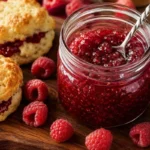
Raspberry Jam Recipe Without Pectin
- Total Time: 8 hours 30 minutes
- Yield: 7 (1/2-pint) jars / 56 servings
- Diet: Vegan
Description
This raspberry jam recipe uses just 3 ingredients and absolutely no pectin to produce a deeply fruity, thick spread that sets beautifully overnight. It takes 30 minutes of active cooking and yields 7 half-pint jars of ruby-red jam that tastes far better than anything from a store shelf.
Ingredients
- 4 cups mashed raspberries (fresh or frozen)
- 4 cups white granulated sugar
- 1 tablespoon freshly squeezed lemon juice
Instructions
- Gather and Prep: Measure and mash raspberries, measure sugar, and squeeze lemon juice. Sterilize jars in boiling water for at least 10 minutes and set on a clean towel.
- First Boil: Add mashed raspberries to a very large, heavy-bottomed pot. Bring to a full boil over medium-high heat and cook for 4 minutes, stirring occasionally.
- Add Sugar and Lemon: Stir in the sugar and lemon juice all at once. Bring the mixture back to a full rolling boil, stirring constantly to prevent scorching.
- Second Boil: Cook at a rolling boil for 4 more minutes, stirring constantly. Remove from heat immediately.
- Fill the Jars: Ladle hot jam into sterilized jars, leaving exactly 1/4 inch of headspace at the top. Wipe jar rims clean with a damp paper towel and apply lids and rings finger-tight.
- Water Bath Process: Lower filled jars into a boiling water bath using a jar lifter, keeping 2 inches of space between jars. Ensure water covers jar tops by at least 1 inch. Cover and process for 10 minutes.
- Rest and Store: Remove jars and set them several inches apart on a towel. Let rest undisturbed for 8 hours before checking seals. Store sealed jars in a cool, dark place for up to 12 months.
Notes
Natural pectin in raspberries and lemon juice sets this jam without any commercial pectin. Do not double the batch, cook in separate pots for consistent results. Use a pot that holds at least 6 quarts to prevent boil-overs. Jam thickens further as it cools, so do not overcook chasing a thick consistency on the stove.
- Prep Time: 5 minutes
- Cook Time: 20 minutes
- Category: Condiment / Preserve
- Method: Stovetop + Water Bath Canning
- Cuisine: American
Common Mistakes to Avoid When Making Raspberry Jam Recipe
| Mistake | Why It Happens | How to Fix It |
|---|---|---|
| Jam does not set | The mixture did not reach a full rolling boil during the second cook, or the batch was doubled and needed a longer cook time. | Pour unsealed jam back into the pot, bring back to a rolling boil, cook for 2 additional minutes, and re-process in fresh jars. |
| Jam is too stiff or rubbery | Overcooked during the second boil or made with underripe raspberries, which are higher in natural pectin and set more aggressively. | Use the frozen plate test before the end of cook time and pull the pot off heat the moment the jam wrinkles on the plate. |
| Jars do not seal properly | Food residue on the jar rim prevented the lid from forming a vacuum seal, or jars were not hot enough before filling. | Always wipe rims thoroughly before applying lids. Keep jars hot in the water bath right up until filling each one. |
| Jam scorches on the bottom | Heat was too high or the jam was not stirred frequently enough during the second boil. | Use a heavy-bottomed pot to distribute heat more evenly, and stir constantly during the sugar-added boil phase. |
| Foam on top of finished jam | Natural proteins in the fruit rise to the surface during cooking. This is cosmetic and does not affect safety or flavor. | Skim foam with a metal spoon after removing from heat, or add 1/4 teaspoon of butter during cooking to suppress foam formation. |
Variations and Substitutions for This Raspberry Recipe
| Ingredient | Substitution | Impact on Flavor and Texture |
|---|---|---|
| Fresh raspberries | Frozen raspberries (thawed and drained) | Nearly identical results. Frozen berries are often picked at peak ripeness and work excellently in this raspberry jam recipe. |
| White granulated sugar | Raw cane sugar | Produces a slightly darker, more caramel-toned jam with a mildly richer sweetness. Set quality remains the same. |
| Pure raspberry jam | Mixed berry version using half raspberries and half blackberries | Deeper flavor with a slight earthiness. Still sets without pectin since blackberries are also high in natural pectin. |
| Lemon juice | Lime juice | Adds a tropical citrus note that pairs well with the berry flavor. The acidity level is similar, so setting is not affected. |
| Standard jam with seeds | Seedless raspberry jelly recipe version (strain all seeds before cooking) | Produces a completely smooth, clear ruby-red jelly with a slightly lighter body. Pass all mashed berries through a fine mesh strainer before cooking. |
Serving Suggestions and Pairings for Raspberry Jam
Raspberry jam belongs on the breakfast table first. Spread it thick on toasted sourdough, buttermilk biscuits, or English muffins with a generous layer of cream cheese underneath. Stir a spoonful into plain Greek yogurt with granola for a breakfast that tastes far better than flavored store-bought varieties. The jam is also a natural companion for classic scones at an afternoon tea spread.
Beyond breakfast, this jam recipe makes a fantastic filling for thumbprint cookies, layer cakes, and crepes. Swirl it through vanilla cheesecake batter before baking, or warm it gently and pour it over vanilla ice cream as a quick raspberry sauce. For entertaining, pair this jam on a cheese board alongside sharp aged cheddar, creamy brie, and water crackers. The tartness of the berries cuts through rich cheese in a way that store-bought jam simply cannot. The baked brie appetizer on this site pairs spectacularly with a spoonful of this homemade raspberry jam melted on top.
For gifting, this jam is one of the most crowd-pleasing options you can bring to a holiday gathering or housewarming. A jar wrapped in kraft paper with a handwritten tag requires almost no extra effort and looks genuinely thoughtful. Pair it with a loaf of garlic herb braided bread for a gift basket that will be remembered long after the jar is empty.
Storage and Reheating
| Storage Method | Duration | Conditions | Indicator of Spoilage |
|---|---|---|---|
| Sealed jars, pantry | Up to 12 months | Cool, dark area away from direct heat and light. Ideal temperature below 75°F (24°C). | Lid that flexes when pressed, off smell when opened, visible mold, or discoloration. |
| Opened jar, refrigerator | Up to 3 weeks | Keep covered with a tight lid. Always use a clean, dry spoon to avoid introducing moisture or bacteria. | Mold growth, fermented smell, or significant color change. |
| Unsealed jar, refrigerator | Up to 3 weeks | Treat as an open jar and refrigerate immediately after the 8-hour rest period. | Same as opened jar indicators above. |
| Freezer (unsealed jars) | Up to 12 months | Use freezer-safe containers. Leave 1/2-inch headspace for expansion. Thaw in refrigerator overnight before using. | Significant ice crystals throughout or separation that does not recombine after stirring. |
Raspberry jam does not need reheating before serving. If jam has set very firm in the jar, let it sit at room temperature for 20 minutes before using, or stir vigorously with a clean spoon to loosen. To use as a warm sauce over desserts, place the desired amount in a small saucepan over low heat and stir gently until liquid and pourable.
Nutritional Information
Approximate values per 1 tablespoon serving.
| Nutrient | Amount per Serving (1 tablespoon) |
|---|---|
| Calories | 45 kcal |
| Total Carbohydrates | 11g |
| Sugar | 11g |
| Dietary Fiber | 0.3g |
| Total Fat | 0g |
| Protein | 0g |
| Sodium | 0mg |
| Vitamin C | Approx. 2% Daily Value |
| Calcium | 0% |
| Iron | 0% |
The Best Raspberry Jam Recipe Easy
This raspberry jam recipe is proof that the simplest approach is often the most reliable. Three ingredients, two short boils, and a few properly sterilized jars are all that stand between you and a pantry stocked with ruby-red raspberry jam that beats anything on a grocery store shelf.
Whether you spread it on morning toast, swirl it into yogurt, or gift a jar to someone who deserves something homemade, the concentrated berry flavor in every spoonful is what keeps people asking for this Raspberry Jam recipe all year long.
Follow me on PINTEREST for all of my latest blog posts, videos, and recipes.

FAQs About Raspberry Jam Recipe
How to make the best raspberry jam?
The best raspberry jam starts with fully ripe, deeply colored raspberries measured after mashing rather than before. Use a 1:1 ratio of mashed berries to sugar, cook in two separate 4-minute boiling stages, and always test for gel point on a frozen plate before pulling the pot from heat. Fresh lemon juice is a small detail that makes a noticeable difference in brightness and helps the natural pectin in the fruit activate properly. For more fruit-forward recipes built on simple technique, take a look at these homemade cranberry recipes that follow the same philosophy.
Do you need pectin for raspberry jam?
No, you do not need commercial pectin to make raspberry jam. Raspberries naturally contain high levels of pectin in their seeds and skins, which releases during cooking and causes the jam to set on its own. The lemon juice in this Raspberry Jam recipe adds the acid needed to activate that natural pectin, making commercial pectin packets completely unnecessary for a firm, spreadable result. This is why raspberry jam is one of the most beginner-friendly jam recipes available.
What are the common mistakes when making jam?
The most common mistake is not reaching a true rolling boil during the second cook, which leaves the jam too loose to set. Doubling the batch in a single pot is another frequent issue that extends cook time unpredictably and often leads to uneven results. Skipping the frozen plate test, leaving food residue on jar rims before sealing, and filling cold jars with hot jam round out the list of issues that most beginners encounter on their first attempt at homemade jam recipes.
How to make raspberry jam Mary Berry style?
Mary Berry’s approach to raspberry jam is notably similar to this Raspberry Jam recipe in that she avoids commercial pectin and relies on the natural setting power of the fruit. Her method typically calls for warming the sugar before adding it to the berries, which speeds up dissolving and can shorten total cook time. She also recommends testing for set on a cold saucer and refrigerating it for a minute before checking the wrinkle. The core principle of a two-stage boil and careful gel-point testing is shared across most classic British jam-making traditions.
Can you use frozen raspberries for this raspberry jam recipe?
Frozen raspberries work very well in this Raspberry Jam recipe and often produce jam that is just as flavorful as fresh-berry versions. Thaw the berries completely and drain off any excess liquid before measuring the 4 cups of mashed fruit. Frozen raspberries are frequently picked and frozen at peak ripeness, which means their natural pectin content is often higher than fresh berries that were harvested early to survive transport.
How long does homemade raspberry jam last?
Properly processed and sealed jars of homemade raspberry jam last up to 12 months stored in a cool, dark pantry. Once a jar is opened, keep it refrigerated and use it within 3 weeks. Any jar that did not seal during the water bath canning process should go straight into the refrigerator and be treated as an already-opened jar with the same 3-week window. Always check that lids feel firm and do not flex before using stored jam.
Can this raspberry jelly recipe be made seedless?
A fully seedless raspberry jelly recipe starts by pressing all the mashed berries through a fine mesh strainer or cheesecloth before cooking, removing the seeds and leaving only juice and pulp. The same 4 cups of strained juice replaces the 4 cups of mashed berries, and the sugar and lemon juice quantities stay identical. The result is a smoother, clearer jelly rather than a textured jam, and the set may be slightly softer since some pectin remains in the seeds and skins that were discarded.