
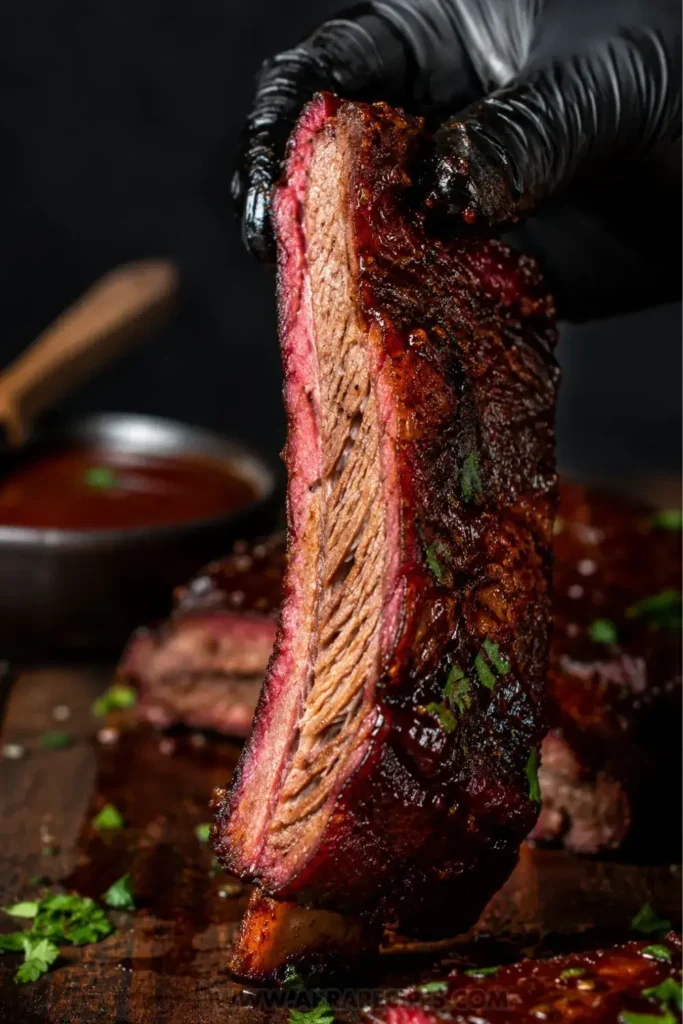
Beef baby back ribs are full-flavored, deeply satisfying racks of meat coated in a bold spice rub and finished with sticky BBQ sauce, ready from your smoker or oven. This beef baby back ribs recipe delivers restaurant-quality results with straightforward techniques anyone can follow at home. The cook time is patient but the payoff is a rack that bends at the center, cracks on top, and pulls apart with almost no effort.
Recipe Overview
| Detail | Info |
|---|---|
| Prep Time | 30 minutes |
| Cook Time | 4 hours 30 minutes |
| Total Time | 5 hours |
| Servings | 4 servings |
| Difficulty | Intermediate |
| Cuisine | American BBQ |
Table of Contents
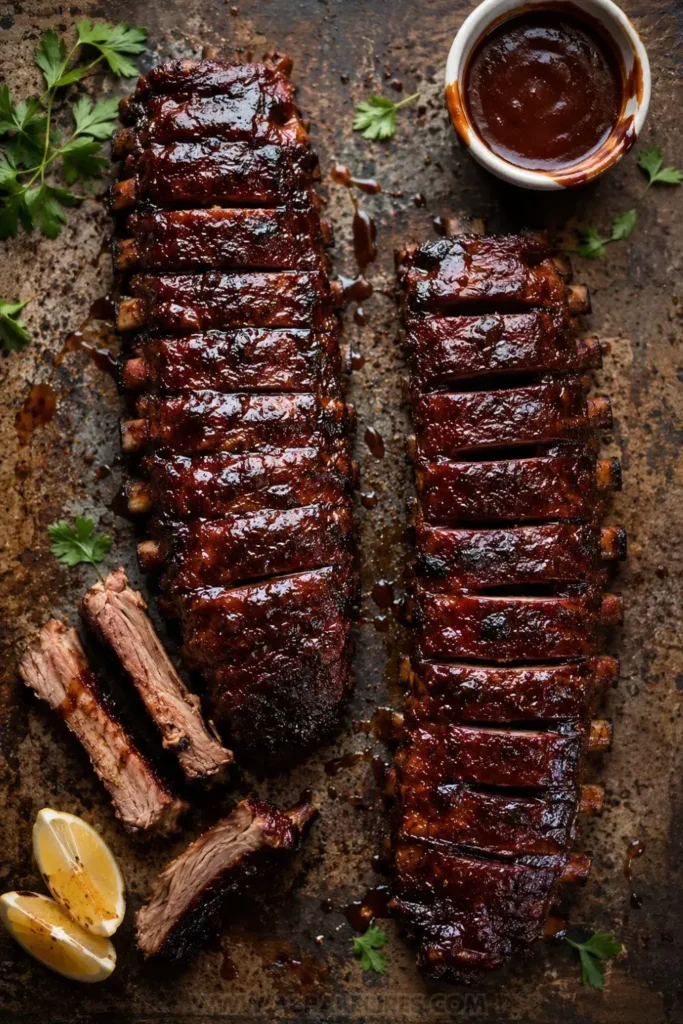
This beef baby back ribs recipe is my absolute go-to whenever I want to cook something that genuinely impresses people without turning the kitchen into a battleground. Over the years of making beef baby back ribs, I have tested every variation imaginable, different rub ratios, foil timing, smoke woods, broiler settings, and the formula you see here is the one that my family always asks for, specifically by name, usually about three days before any gathering.
The spice rub is the foundation: smoked paprika and garlic powder do the heavy lifting, while cayenne adds just enough heat to keep things interesting without overwhelming the beef.
One thing I used to struggle with was getting the membrane off the back of the ribs cleanly. I discovered that slipping a butter knife under the membrane at one of the end bones, then grabbing the loosened edge with a dry paper towel, gives you the grip you need to peel it off in one long pull. Wet hands fail every time, the paper towel is non-negotiable.
Another tip worth knowing: apply the rub in two layers. Coat the racks, let them sit for 15 minutes so the surface moisture sweats the rub into a tacky paste, then apply the second coat. It looks excessive. It is not. That double application is what builds the bark on beef baby back ribs.
Why This Beef Baby Back Ribs Recipe Works
The spice rub on these beef baby back ribs is built around balance rather than heat alone. Smoked paprika provides color and a gentle wood-smoke flavor that complements actual smoke (or mimics it in the oven). Sugar encourages caramelization during the final cooking phase, which gives the bark its characteristic stickiness and bite.
Cumin and dried oregano add depth that keeps the overall flavor from reading as one-dimensional, which is a common issue with simpler rubs.
Low-and-slow cooking is what separates acceptable ribs from unforgettable ones. At 225°F in the smoker or 300°F in the oven, the collagen in the connective tissue has time to convert into gelatin, which bastes the beef baby back ribs from the inside as they cook. Rushing that process with high heat produces ribs that are technically cooked but tight, chewy, and dry.
The foil wrap phase, often called the Texas crutch, accelerates this collagen breakdown by trapping steam around the meat, which is why the racks become noticeably more tender after that step.
The BBQ sauce goes on late for a deliberate reason. Adding sauce early means the sugars burn before the beef baby back ribs finish cooking.
Applied in the final 45 minutes to 1 hour in the smoker, or under the broiler in the oven, the sauce has just enough time to set, bubble slightly, and develop a lacquered crust rather than a charred one. If you want to build your own classic BBQ ribs foundation before experimenting with beef back ribs, that experience transfers directly to this recipe.
Ingredients for Beef Baby Back Ribs
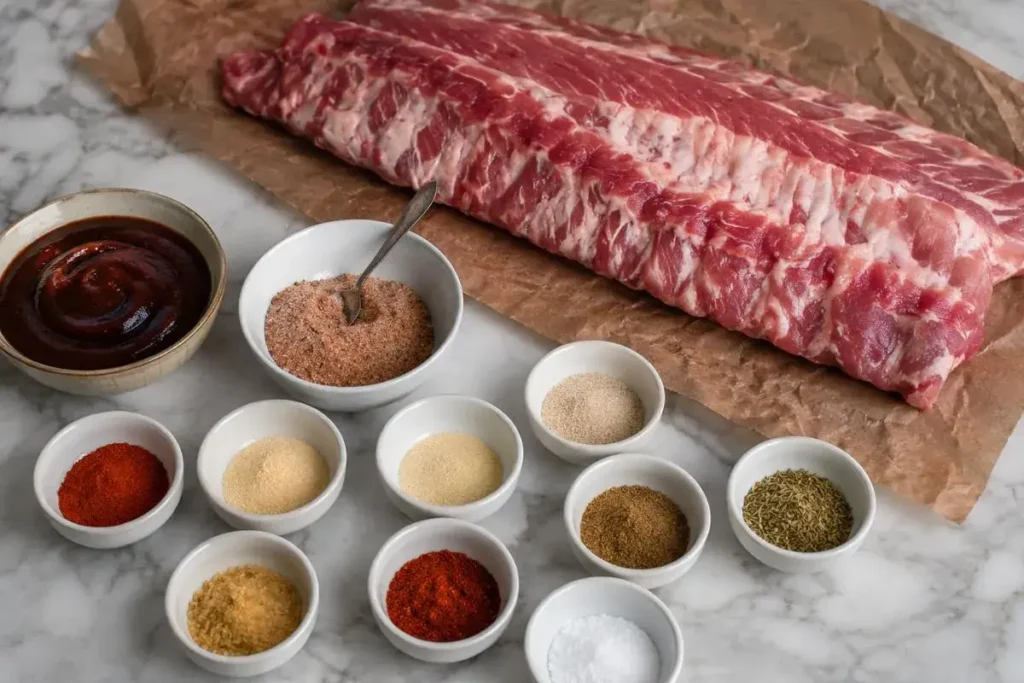
| Ingredient | Quantity | Notes / Alternatives |
|---|---|---|
| Sugar | 3 tablespoons | Brown sugar adds molasses depth; white sugar works fine |
| Salt | 2 teaspoons | Kosher salt preferred; reduce by 25% if using fine table salt |
| Smoked paprika | 1½ tablespoons | Regular paprika works but loses the smoky undertone |
| Garlic powder | 1½ teaspoons | Fresh minced garlic burns during long cooks; powder is correct here |
| Onion powder | 1½ teaspoons | Not interchangeable with garlic powder, use both |
| Ground cumin | 1 teaspoon | Skip if you dislike earthy notes; coriander is a mild substitute |
| Dried oregano | 1 teaspoon | Italian or Mexican oregano both work well here |
| Ground mustard | ½ teaspoon | Adds tang without an obvious mustard flavor; do not skip |
| Cayenne pepper | ½ teaspoon | Reduce to ¼ teaspoon for milder heat; chipotle powder adds smokier heat |
| Beef baby back ribs | 2 racks | Look for racks with even meat coverage and minimal large fat caps |
| BBQ sauce | About 6 tablespoons | Homemade or store-bought; choose one with lower sugar content to avoid burning |
Mise en Place and Prep Steps
- Measure all spice rub ingredients into a medium bowl and whisk until fully combined with no visible clumps.
- Pat both racks of beef baby back ribs completely dry with paper towels, moisture prevents the rub from adhering.
- Using a butter knife, work under the membrane at one end bone on the back of each rack of beef baby back ribs, loosening it from the bone.
- Grip the loosened membrane firmly with a dry paper towel and pull it off in one motion; repeat on the second rack.
- Set the beef baby back ribs on a clean cutting board or baking sheet, bone-side down, ready to receive the rub.
- If using the smoker method, preheat to 225°F and prepare your wood chips or chunks. If using the oven, set racks to middle and top positions and preheat to 300°F.
- Tear two large sheets of heavy-duty aluminum foil and set aside for the wrapping step, each sheet should be twice the length of a rack.
How To Make Beef Baby Back Ribs Step by Step
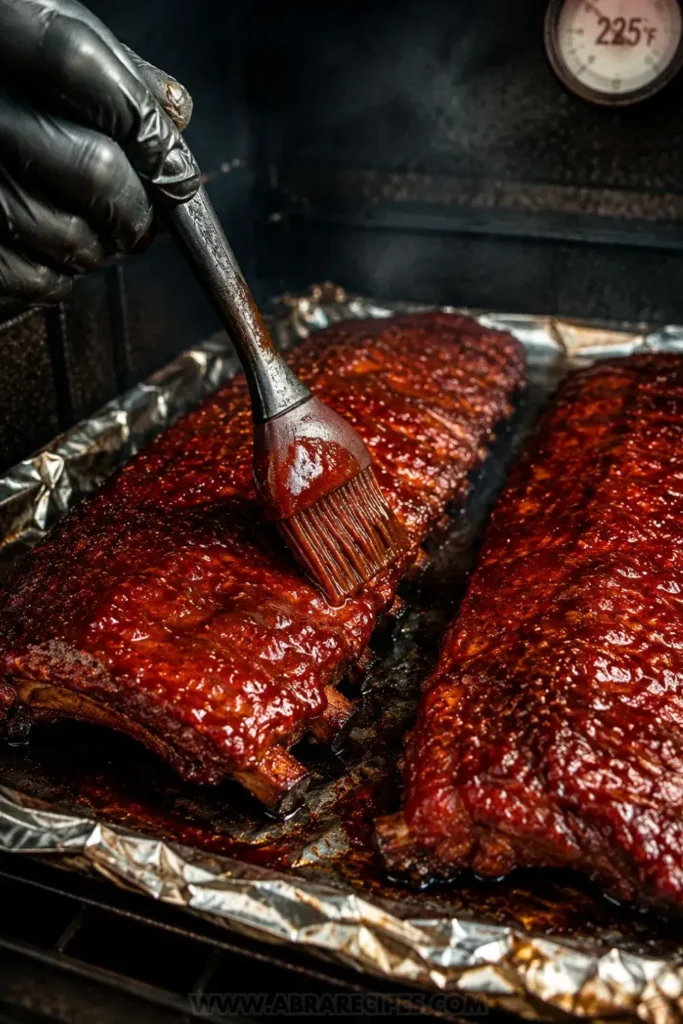
Apply the Rub
- Coat both sides of each rack of beef baby back ribs evenly with approximately half of the spice rub mixture, pressing it gently into the meat.
- Rest the coated racks at room temperature for 15 minutes until the surface looks damp and the rub has bonded to the meat.
- Apply the remaining rub in a second layer across both racks, covering all surfaces including the sides and ends.
Smoker Method
- Place the spice-coated beef baby back ribs directly in the preheated 225°F smoker, bone-side down, and smoke undisturbed for 2 hours.
- Remove the racks from the smoker and double-wrap each one tightly in heavy-duty aluminum foil, pressing the edges to seal completely.
- Return the foil-wrapped beef baby back ribs to the smoker and cook for 1 hour and 30 minutes.
- Carefully lift the wrapped racks from the smoker, hot grease has accumulated inside the foil, so tilt away from your body before opening.
- Unwrap the racks gently, leaving them resting on the foil, and brush the top of each rack with approximately 3 tablespoons of BBQ sauce.
- Fold the foil edges upward around each rack to create a shallow pan that catches drips without covering the meat.
- Return the open foil pans to the smoker and cook for 45 minutes to 1 hour more, until the beef baby back ribs bend noticeably at the center when lifted with tongs and the meat cracks along the top.
- Rest the finished racks covered loosely for 10 minutes, then slice between each bone and serve with extra BBQ sauce on the side.
Oven Method
- Line a large baking sheet with heavy-duty aluminum foil and arrange the spice-rubbed beef baby back ribs on it, bone-side down.
- Cover the pan tightly with another sheet of foil, crimping the edges to create a sealed environment, and bake at 300°F for 2 hours.
- Remove the top layer of foil and switch the oven to the broil setting.
- Brush each rack with 3 tablespoons of BBQ sauce and slide the pan under the broiler on the top rack.
- Broil for 2 to 4 minutes, watching constantly, the sugars in both the rub and the sauce will go from caramelized to burned quickly.
- Rest the beef baby back ribs for 10 minutes before slicing and serving. Alternatively, skip the broiler and finish the baked racks on a medium-heat grill for 10 to 15 minutes, brushing occasionally with additional BBQ sauce until charred in spots.
Beef Baby Back Ribs in the Oven Method
- Preheat the oven to 300°F (150°C) and position one rack in the middle of the oven.
- Line a large rimmed baking sheet with heavy-duty aluminum foil, leaving enough overhang on all sides to wrap the beef baby back ribs completely.
- Place the spice-rubbed beef baby back ribs on the prepared baking sheet, bone-side down, in a single layer.
- Fold the foil up and over the racks, crimping the edges tightly on all sides to create a fully sealed packet that traps steam inside.
- Slide the pan into the middle rack of the oven and bake for 2 hours without opening the foil, the sealed environment is what converts the collagen into gelatin.
- Carefully remove the pan from the oven and open the foil away from you, since pressurized steam will release immediately.
- Switch the oven setting to broil and move the oven rack to the top position.
- Brush the top of each rack of beef baby back ribs generously with 3 tablespoons of BBQ sauce, coating the entire surface evenly.
- Slide the pan under the broiler and cook for 2 to 4 minutes, watching every 30 seconds, the sugars in the rub and sauce caramelize fast and can burn without warning.
- Pull the beef baby back ribs the moment the sauce bubbles and darkens into a lacquered glaze, then transfer to a cutting board.
- Rest for 10 minutes before slicing between each bone and serving with extra BBQ sauce on the side.
Beef Baby Back Ribs on the Grill Method
- Preheat the grill to medium heat, approximately 300°F to 325°F, and set it up for indirect cooking by leaving one side of the burners off or banking the charcoal to one side.
- Place the spice-rubbed beef baby back ribs on the indirect heat side of the grill, bone-side down, away from direct flame.
- Close the lid and cook the beef baby back ribs over indirect heat for 1 hour and 30 minutes, maintaining a steady temperature throughout without lifting the lid frequently.
- Tear two large sheets of heavy-duty aluminum foil and place each rack meat-side down in the center of a sheet, then fold and crimp the foil tightly to seal.
- Return the foil-wrapped beef baby back ribs to the indirect heat side of the grill, close the lid, and cook for another 45 minutes to 1 hour.
- Carefully unwrap each rack onto the foil, bone-side down, and brush the meat side with 3 tablespoons of BBQ sauce.
- Move the sauced racks directly over the heat source, meat-side down, and grill over direct medium heat for 3 to 5 minutes until the sauce caramelizes and grill marks develop.
- Flip the beef baby back ribs bone-side down over direct heat for 2 minutes more, then move back to indirect heat if the sauce threatens to burn.
- Check for doneness by lifting the center of each rack with tongs, the rack should bend deeply at both ends and the top surface should crack slightly.
- Transfer to a cutting board, rest for 10 minutes, slice between the bones, and serve with additional BBQ sauce.
Beef Baby Back Ribs in the Crockpot Method
- Cut each spice-rubbed beef baby back rack into sections of 3 to 4 ribs each so they fit inside the slow cooker without forcing or bending the bones at sharp angles.
- Stand the beef baby back rib sections upright along the inner wall of the slow cooker, bone-side facing outward, meat-side facing the center, this position allows even heat circulation around every section.
- Pour 3 tablespoons of BBQ sauce over the rib sections, letting it run down into the gaps between pieces.
- Place the lid on the slow cooker and cook on LOW for 6 to 7 hours or on HIGH for 3 to 4 hours, do not lift the lid during cooking, as each peek adds 20 to 30 minutes to the cook time.
- Check for doneness at the lower end of the time range by pressing the meat with a fork, beef baby back ribs are ready when the meat gives way easily and begins pulling back from the bone tips by at least a quarter inch.
- Carefully lift each rib section out of the slow cooker using tongs and a wide spatula, since the meat will be very tender and may begin to separate from the bone during handling.
- Transfer the sections to a foil-lined baking sheet, bone-side down, in a single layer.
- Brush the top of each section generously with the remaining BBQ sauce, covering all exposed meat.
- Set the oven to broil and slide the baking sheet under the broiler on the top rack for 3 to 5 minutes until the sauce caramelizes and the surface develops color and texture, watch constantly to prevent burning.
- Rest the finished beef baby back ribs on the baking sheet for 5 minutes, then slice between the bones and serve immediately.
Smoked Beef Baby Back Ribs Method
- Fill the smoker’s water pan and preheat to a steady 225°F, choosing a wood that complements beef, hickory and oak both produce a bold smoke flavor, while cherry wood adds a mild, slightly sweet note.
- Place the spice-rubbed beef baby back ribs directly on the smoker grates, bone-side down, with at least 1 inch of space between each rack for smoke to circulate freely.
- Insert a leave-in probe thermometer into the thickest part of the meat on one rack of beef baby back ribs, away from the bone, to monitor internal temperature throughout the cook.
- Close the smoker lid and smoke undisturbed at 225°F for 2 hours, resist opening the lid, since every opening drops the chamber temperature and adds time to the cook.
- After 2 hours, check the color of the bark; it should be a deep reddish-mahogany. The internal temperature of the beef baby back ribs will likely read between 160°F and 170°F at this point, which is expected.
- Remove the racks from the smoker and double-wrap each one tightly in two layers of heavy-duty aluminum foil, pressing the edges closed to seal in all accumulated juices and steam.
- Return the foil-wrapped beef baby back ribs to the smoker at 225°F and cook for an additional 1 hour and 30 minutes, this is the phase where collagen fully converts and the racks become deeply tender.
- Remove the wrapped racks from the smoker carefully, holding them level since a significant amount of hot liquid has collected inside the foil.
- Open each packet slowly and away from your face, then rest the unwrapped beef baby back ribs on the foil for 5 minutes to allow the surface to dry slightly before saucing.
- Brush 3 tablespoons of BBQ sauce across the top of each rack in a thin, even layer and fold the foil edges upward to form a shallow tray around each rack.
- Return the open foil trays to the smoker and cook for a final 45 minutes to 1 hour at 225°F, until the sauce sets into a tacky glaze and the beef baby back ribs bend at the center when lifted with tongs.
- Remove from the smoker, rest uncovered for 10 minutes, slice between each bone, and serve with additional BBQ sauce alongside.
Chef Tips for Perfect Beef Baby Back Ribs
- Always remove the membrane. Skipping this step produces a rubbery, chewy layer on the back of every rib that no amount of cooking time will fix. Removing it before adding the rub lets flavor penetrate from both sides of the beef baby back ribs.
- Use all of the rub. The quantity feels excessive during application. It is calibrated to create a proper bark on beef baby back ribs. Spread it evenly, press it in firmly, and trust the recipe, do not hold any back.
- Do not open the foil wrap early. The foil phase traps steam and cooks the collagen out of the connective tissue. Opening the package even briefly releases that accumulated steam and adds time to your cook.
- Test for doneness by lifting, not cutting. Grip each rack of beef baby back ribs in the center with tongs and lift. Properly done racks will bend deeply at both ends and the top surface will crack, this bend test is more reliable than internal temperature for this cut.
- Rest before slicing. A 10-minute rest after the final cook phase allows the juices to redistribute into the meat rather than running out onto the cutting board when you slice.
- Apply BBQ sauce only in the final phase. Earlier application allows the sugars to carbonize during the long cook. Added late, the sauce glazes and sets without burning, producing that lacquered, sticky exterior that makes beef baby back ribs so visually compelling.
Common Mistakes to Avoid For Beef Baby Back Ribs
| Mistake | Why It’s a Problem | How to Fix It |
|---|---|---|
| Skipping the membrane removal | The membrane becomes tough and leathery during cooking, creating an unpleasant texture barrier between the meat and the seasoning | Use a butter knife to loosen it at the end bone, then pull it off with a paper towel before any rub is applied to the beef baby back ribs |
| Cooking at too high a temperature | Higher heat tightens the muscle fibers before collagen has time to convert, producing dry, chewy meat rather than tender beef baby back ribs | Hold the smoker at 225°F or the oven at 300°F for the entire cook, resist the urge to speed things up |
| Adding BBQ sauce too early | The sugar in the sauce burns at sustained heat, producing bitter, blackened patches that mask the flavor of the spice rub | Apply sauce only in the final 45 to 60 minutes of the smoker cook, or right before the broiler step when making beef baby back ribs in the oven |
| Skipping the foil wrap | Without the steam environment created by the foil, the connective tissue takes significantly longer to break down, and the beef baby back ribs can dry out before becoming tender | Double-wrap each rack tightly in heavy-duty foil and seal the edges completely to trap steam effectively |
| Cutting into the rack immediately after cooking | Slicing hot beef baby back ribs causes the internal juices to run out rapidly, leaving the meat drier than it should be | Rest the finished racks for at least 10 minutes before slicing between the bones |
Variations and Substitutions For Beef Baby Back Ribs
| Ingredient | Substitution | Impact on Flavor |
|---|---|---|
| White sugar (in rub) | Brown sugar | Adds a light molasses note and slightly deeper color to the bark |
| Smoked paprika | Regular sweet paprika | Loses the smoky undertone; use chipotle powder at half the quantity for partial compensation |
| Cayenne pepper | Chipotle powder | Shifts the heat from sharp to smoky; reduces overall spice intensity slightly |
| Dried oregano | Dried thyme | Thyme is slightly more floral and less earthy; the difference is subtle in the finished rub |
| Store-bought BBQ sauce | Homemade BBQ sauce | Homemade allows full control over sweetness and heat; can be tuned to match the rub profile exactly |
| Smoker (cooking method) | Oven with broiler finish | The oven method produces excellent results with beef baby back ribs; smoke flavor will be absent unless liquid smoke is added to the sauce |
Beef Baby Back Ribs Recipe
- Total Time: 5 hours
- Yield: 4 servings 1x
Description
Beef baby back ribs coated in a bold smoked paprika and garlic powder spice rub, slow-cooked until the racks bend and crack, then finished with sticky BBQ sauce. This recipe covers every method, smoker, oven, grill, and crockpot, so you can make perfect beef baby back ribs with whatever equipment you have on hand.
Ingredients
- 3 tablespoons sugar
- 2 teaspoons salt
- 1½ tablespoons smoked paprika
- 1½ teaspoons garlic powder
- 1½ teaspoons onion powder
- 1 teaspoon ground cumin
- 1 teaspoon dried oregano
- ½ teaspoon ground mustard
- ½ teaspoon cayenne pepper
- 2 racks beef baby back ribs, membrane removed
- About 6 tablespoons BBQ sauce, homemade or store-bought, plus more for serving
Instructions
- Make the Spice Rub: Whisk together sugar, salt, smoked paprika, garlic powder, onion powder, cumin, oregano, ground mustard, and cayenne pepper in a medium bowl until fully combined with no visible clumps.
- Remove the Membrane: Slide a butter knife under the membrane at one end bone of each rack of beef baby back ribs, loosen it, then grip with a dry paper towel and pull it off completely in one motion.
- Apply the First Coat of Rub: Pat both racks completely dry with paper towels. Coat both sides of each rack with half the spice rub, pressing firmly into the meat. Let the racks rest at room temperature for 15 minutes until the surface looks damp and tacky.
- Apply the Second Coat: Cover all surfaces of each rack with the remaining rub — use every bit of it. It looks excessive; it is not.
- Smoker Method – First Smoke: Preheat smoker to 225°F with hickory or oak wood. Place beef baby back ribs bone-side down and smoke undisturbed for 2 hours.
- Foil Wrap (Smoker): Double-wrap each rack tightly in heavy-duty foil. Return to smoker for 1 hour 30 minutes.
- Final Glaze and Set (Smoker): Carefully unwrap racks onto the foil, brush each with 3 tablespoons BBQ sauce, fold foil into a shallow pan, and return to smoker for 45 minutes to 1 hour until the rack bends deeply at the center when lifted with tongs.
- Oven Method – Covered Bake: Place spice-rubbed beef baby back ribs on a foil-lined baking sheet bone-side down, cover tightly with foil, and bake at 300°F for 2 hours.
- Broiler Finish (Oven): Remove top foil, brush racks with 3 tablespoons BBQ sauce each, and broil on the top rack for 2 to 4 minutes, watching every 30 seconds until the sauce bubbles and caramelizes.
- Grill Method: Cook spice-rubbed beef baby back ribs over indirect heat at 300°F to 325°F for 1 hour 30 minutes, foil-wrap and cook 45 minutes more, then finish directly over the flame for 3 to 5 minutes per side with BBQ sauce.
- Crockpot Method: Cut racks into 3 to 4-rib sections, stand upright in the slow cooker, add 3 tablespoons BBQ sauce, and cook on LOW 6 to 7 hours or HIGH 3 to 4 hours. Finish under the broiler for 3 to 5 minutes after transferring to a foil-lined baking sheet.
- Rest and Serve: Rest all finished beef baby back ribs for 10 minutes regardless of method. Slice between bones and serve with additional BBQ sauce on the side.
Notes
Always remove the membrane before applying the rub, a dry paper towel gives the grip you need to pull it off cleanly.
Apply the spice rub in two layers with a 15-minute rest between coats for the best bark. Never add BBQ sauce early in the cook; it belongs in the final phase only. Test doneness by lifting the rack at the center with tongs, it should bend deeply at both ends and crack along the top surface. Rest for 10 minutes before slicing.
To make ahead, apply the rub up to 24 hours in advance and refrigerate uncovered. Reheat at 250°F covered in foil for 30 to 35 minutes, then uncover for 10 to 15 minutes to reset the bark.
- Prep Time: 30 minutes
- Cook Time: 4 hours 30 minutes
- Category: Main Dish
- Method: Smoker, Oven, Grill, or Crockpot
- Cuisine: American BBQ
Nutrition
- Serving Size: 1 serving (1/4 of recipe)
- Calories: 520
- Sugar: 16g
- Sodium: 780mg
- Fat: 28g
- Saturated Fat: 10g
- Unsaturated Fat: 16g
- Trans Fat: 0g
- Carbohydrates: 22g
- Fiber: 1g
- Protein: 38g
- Cholesterol: 110mg
Keywords: beef baby back ribs recipe, easy beef back ribs recipe, beef back ribs cooking time, smoked beef baby back ribs, beef baby back ribs in the oven, beef baby back ribs on the grill, beef baby back ribs crockpot, smoked paprika ribs, bbq sauce ribs, slow cooker ribs, easy meal ideas
Serving Suggestions and Pairings For Beef Baby Back Ribs
Beef baby back ribs are a centerpiece dish that works across a wide range of occasions. For a backyard BBQ, slice the racks at the table and serve them directly on a large wooden board alongside a crisp homemade coleslaw and a simple classic potato salad, those two cold sides balance the richness of beef baby back ribs beautifully. Corn on the cob, baked beans, or roasted sweet potato rounds all work as warm sides for the same meal.
For a more structured dinner, beef baby back ribs pair well with a cheesy broccoli casserole and thick-cut Texas toast. If you are looking for an easy meal idea that feeds a crowd without multiple pots running simultaneously, set up a rib station with the meat, two or three cold salads, and a selection of extra sauces on the table. The beef back ribs cooking time is long, but the active work is minimal, which makes this format ideal for hosting.
For a game-day spread, serve sliced beef baby back ribs alongside crispy air fryer wings and a cold, creamy dip. The contrast between the smoky ribs and the lighter bites keeps the spread from feeling repetitive. Beef baby back ribs also hold well on a warming tray for up to 45 minutes, making them one of the better options for buffet-style serving.
Storage and Reheating
Cooked beef baby back ribs store well and reheat without significant quality loss when handled correctly. Place cooled racks or sliced portions in an airtight container and refrigerate for up to 3 to 4 days. For longer storage, wrap each rack of beef baby back ribs tightly in plastic wrap, then in a layer of foil, and freeze for up to 3 months.
To reheat, thaw overnight in the refrigerator if frozen, then place the beef baby back ribs on a foil-lined baking sheet. Brush with a fresh layer of BBQ sauce, cover the pan tightly with foil, and warm in a 250°F oven for 30 to 35 minutes. Remove the foil and continue heating for another 10 to 15 minutes to allow the sauce to set and the bark to regain some of its texture. Microwaving is a last resort, it heats the meat unevenly and softens the bark completely.
Nutritional Information
Approximate values per serving (based on 4 servings per recipe).
| Nutrient | Amount per Serving |
|---|---|
| Calories | ~520 kcal |
| Protein | ~38g |
| Total Fat | ~28g |
| Saturated Fat | ~10g |
| Carbohydrates | ~22g |
| Sugar | ~16g |
| Fiber | ~1g |
| Sodium | ~780mg |
| Cholesterol | ~110mg |
The Best Beef Baby Back Ribs Recipe
This beef baby back ribs recipe produces racks that are deeply seasoned, fall-tender at the bone, and finished with a sticky, caramelized BBQ glaze that makes every bite satisfying.
Whether you use the smoker for maximum smoke flavor or the oven for everyday convenience, beef baby back ribs deliver results that hold their own against anything from a professional BBQ kitchen. Apply the rub generously, trust the low-and-slow process, and let the heat do the work.
Follow me on PINTEREST for all of my latest blog posts, videos, and recipes.
FAQs About Beef Baby Back Ribs
What is the correct beef back ribs cooking time for the oven method?
The oven method for beef baby back ribs takes approximately 2 hours covered at 300°F, followed by 2 to 4 minutes under the broiler for the BBQ sauce glaze. Total active and passive time runs about 2 hours and 30 minutes from when the racks go into the oven. This makes beef baby back ribs one of the more straightforward easy meal ideas for a weekend afternoon that does not require special equipment.
Can I make this easy beef back ribs recipe without a smoker?
The oven-to-broiler method in this beef baby back ribs recipe produces tender, flavorful results without any outdoor equipment. The primary difference is that oven-cooked beef baby back ribs will not have a true smoke ring or wood-smoke flavor. Adding half a teaspoon of liquid smoke to the BBQ sauce before brushing it on compensates partially for that absence.
How do I know when beef baby back ribs are done cooking?
Grip the rack of beef baby back ribs in the center with tongs and lift, the rack should bend deeply at both ends and the surface meat should crack slightly along the top. A finished rack also pulls back from the bone tips visibly, typically by about a quarter inch. Internal temperature for beef baby back ribs should read between 195°F and 203°F, which is the range where collagen fully converts.
What is the best BBQ sauce for beef baby back ribs?
A sauce with a moderate sugar level and some vinegar acidity works best for beef baby back ribs, since the spice rub already has sugar in it. Overly sweet commercial sauces can produce a cloying result when layered on top of a sugared rub. A Kansas City-style sauce or a Texas-style sauce with tomato and mild heat both pair well with the smoked paprika and garlic powder in the rub.
Can I prep beef baby back ribs ahead of time?
Apply the spice rub up to 24 hours in advance and refrigerate the beef baby back ribs uncovered on a baking sheet, the dry surface that forms overnight helps build a better bark during cooking. Remove the racks from the refrigerator 30 minutes before cooking to take the chill off the meat before it goes into the smoker or oven. The finished beef baby back ribs also reheat well, so cooking a day ahead and reheating is a practical strategy for events.
Are beef baby back ribs different from beef back ribs?
Beef baby back ribs come from the upper rib cage near the backbone and are shorter and slightly more curved than standard beef back ribs. Both cuts come from the same general area and cook well with low-and-slow methods, but baby backs tend to have a higher meat-to-bone ratio and a slightly more tender texture. The recipe and timing here applies equally well to either cut, though larger racks may need an extra 30 minutes in the foil phase.